

Project Overview
The Irish Water National Laboratory in Ballysimon Road, Limerick required a robust laboratory airflow solution capable of maintaining safe working conditions across a wide range of laboratory and support spaces, while also allowing for operational efficiency and future growth.
Critical Airflow was appointed to supply, integrate and commission the laboratory airflow and air quality systems, bringing together best-in-class technologies from Phoenix Controls, Strobic Air and Aircuity into a single, coordinated solution.
The result is a laboratory environment where airflow, pressure and air quality are continuously managed in response to real conditions, rather than fixed assumptions.
The Challenge
The facility includes multiple laboratories with differing airflow and pressurisation requirements, alongside corridors, support areas and shared spaces. Key challenges included:
This required close coordination between airflow control, air quality monitoring and exhaust systems.
The Solution
Critical Airflow delivered an integrated solution built around three core systems.
Strobic Air – Fume Cupboard Extract
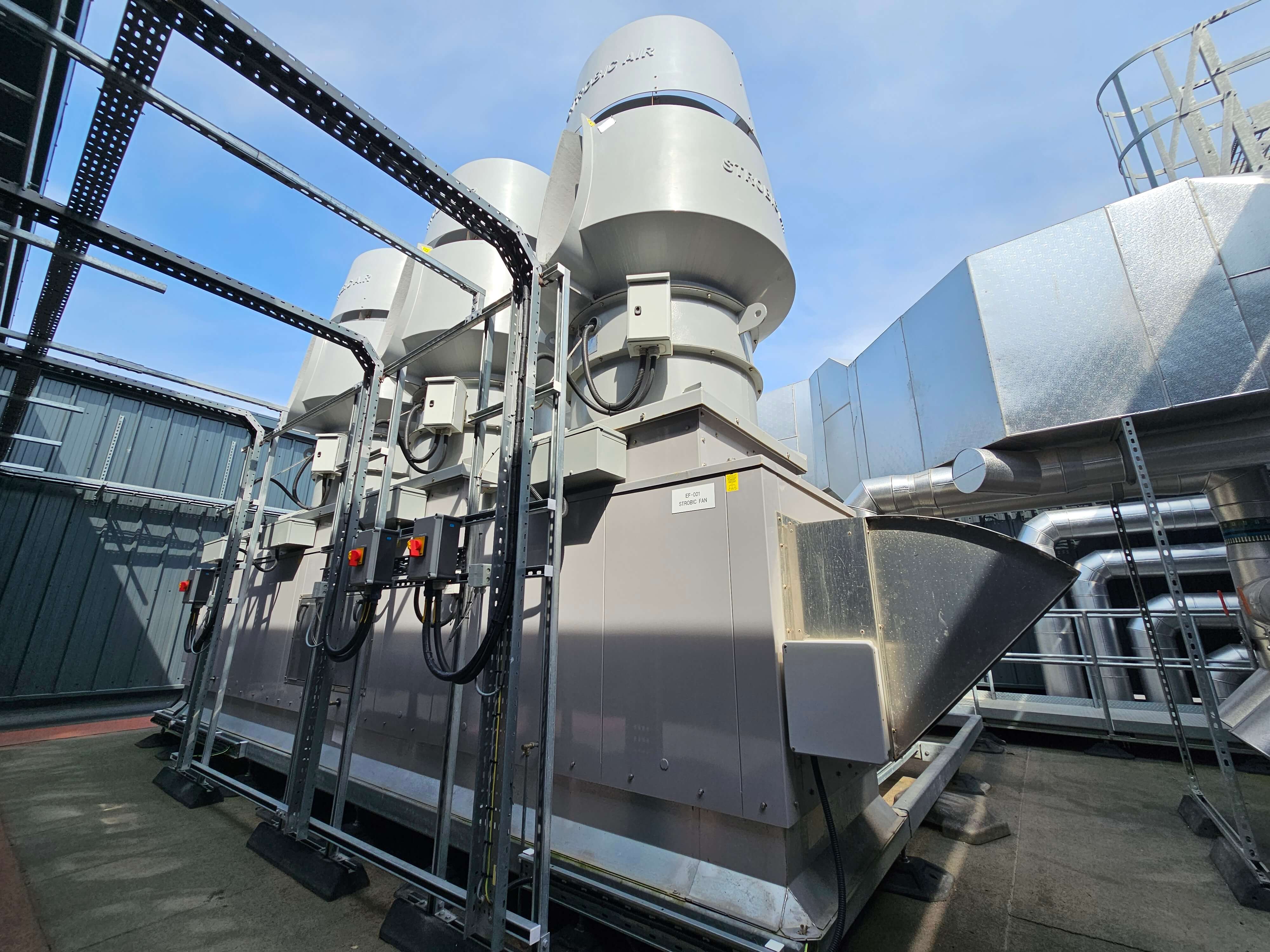
A Strobic four-stage fan plenum system was installed to serve the laboratory fume cupboards. Three fans operate under normal conditions, with a fourth fan provided as a spare for future capacity and resilience.
The system delivers fume cupboard extract to a high external discharge level, supporting effective plume dispersion and safe removal of contaminants. As part of the exhaust process, extract air from the facility is diluted with fresh air within the Strobic system before discharge, further supporting safe dispersion.
The plenum arrangement also allows future increases in demand without disruption to existing operations.
Aircuity – Centralised Air Quality Monitoring
Aircuity air quality monitoring was implemented across 25 rooms within the facility.
Air samples are drawn from each monitored space and analysed centrally. The system continuously assesses air quality and shares this information with the laboratory airflow controls.
When air quality is good, a signal is sent to the relevant Phoenix VAV valves to reduce airflow to minimum safe levels. When air quality degrades, airflow is automatically increased. This demand-led approach allows the building to respond dynamically to real conditions.
Phoenix Controls – Laboratory Airflow and Temperature Control
Phoenix Controls systems manage airflow and temperature across 30 rooms, providing tracked supply and exhaust control. Four laboratories operate with a fixed negative pressure offset, alongside temperature control, to support containment requirements.
The Phoenix system integrates directly with the Aircuity platform, enabling air change rates to be reduced during periods of good air quality while still maintaining room balance, pressure relationships and thermal comfort.
All control operates on a pressure-independent basis, ensuring stable performance even as duct pressures fluctuate.
Integration and Commissioning
Critical Airflow was responsible for the full integration of the Strobic, Aircuity and Phoenix systems, ensuring each element communicated correctly and responded as intended.
All systems were integrated with the on-site Building Management System, providing the client with full visibility of system status, performance and alarms.
Commissioning focused on verifying room balance, airflow tracking, pressure offsets and air quality response across all controlled spaces. Detailed operating and maintenance documentation was provided for each system to support ongoing operation.
Outcomes and Benefits
The completed installation delivers a laboratory environment that is both safe and adaptable.
Summary
This project demonstrates Critical Airflow’s ability to deliver integrated laboratory airflow solutions that balance safety, control and efficiency.
By combining Strobic exhaust systems, Aircuity air quality monitoring and Phoenix laboratory airflow control, the Irish Water National Laboratory benefits from a responsive, future-ready system designed around how the building is actually used.